About me

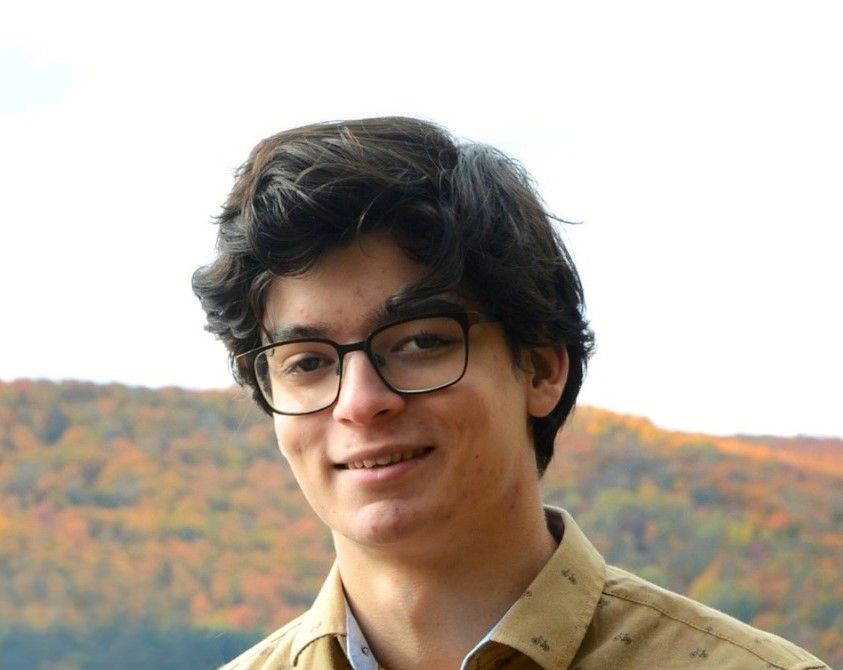
Hi, I'm Jaeden! I am a Caltech Ph.D. student and NSERC Graduate Fellow interested in how supermassive black holes (SMBH) grow, evolve and influence their environments across multiple scales. This includes active galactic nuclei (AGN) feedback, structure and spectral evolution, multi-messenger signatures of merging SMBHs, and characterizing little red dots (LRDs). I often use radiative transfer (RT) and magnetohydrodynamics (MHD) hyper-refinement simulations on high-performance computing hardware, and data analysis including machine learning and various other statistical techniques.

I also have a passion for teaching and enjoy volunteer tutoring and serving as a teaching assistant whenever I can. Through my co-directorship of the Caltech Project for Effective Teaching (CPET), I oversee and facilitate a series of programs and workshops geared towards evidence-based teaching for graduate students and postdocs.

My Research

Active Galactic Nucleus Structure

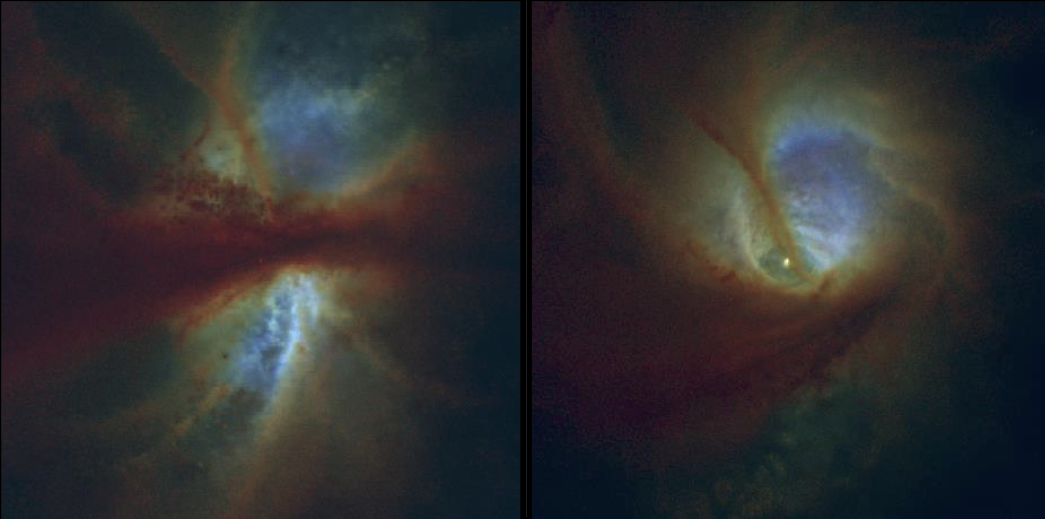
Recent hyper-refinement magnetohydrodynamical simulations of active galactic nuclei (AGN) have allowed for the study of physics continuously from cosmological scales down to the innermost stable circular orbit (ISCO) of a central supermassive black hole. This allows us to describe, for the first time, the steady-state structure and evolution of AGN without assuming phenomenological structure or idealized initial conditions.

In Bardati et al. (2026a), we describe one such self-consistently formed dust torus, composed of the hyper-magnetized accretion disk plus an asymmetric dusty inflowing stream that fuels accretion and predict its resulting infrared spectrum. In Bardati et al. (2026c, in prep), we also show that a combination of the disk and outflow components produces a broad line region inside the dust sublimation region that fits well with observed relations. The full simulation is described in Hopkins et al. (2025).
Hot Dust Obscured Galaxies

Resolving dust and stars in a galaxy down to the dust sublimation region and the end of star formation allows us to describe the heating mechanisms of dust that give rise to infrared spectra in ultra-luminous infrared galaxies, which is not always easy to decompose in observations.

We use our hyper-refinement simulation of an obscured quasar in Bardati et al. (2026b) to show how AGN- and starburst-heated dust come together to produce a spectrum similar to the rare class of high-redshift objects known as hot dust obscured galaxies (Hot DOGs). This suggests that Hot DOGs are short transitional events during super-Eddington accretion periods before significant outflows clear optically thin paths.

Signatures of Supermassive Black Hole Merger Host Galaxies

Mergers of supermassive black holes (SMBH) produce gravitational waves detectable by future experiments such as LISA or pulsar timing arrays (PTAs). However, finding the host galaxy of a detected SMBH merger is not trivial and new methods are needed to fully identify the host galaxy.

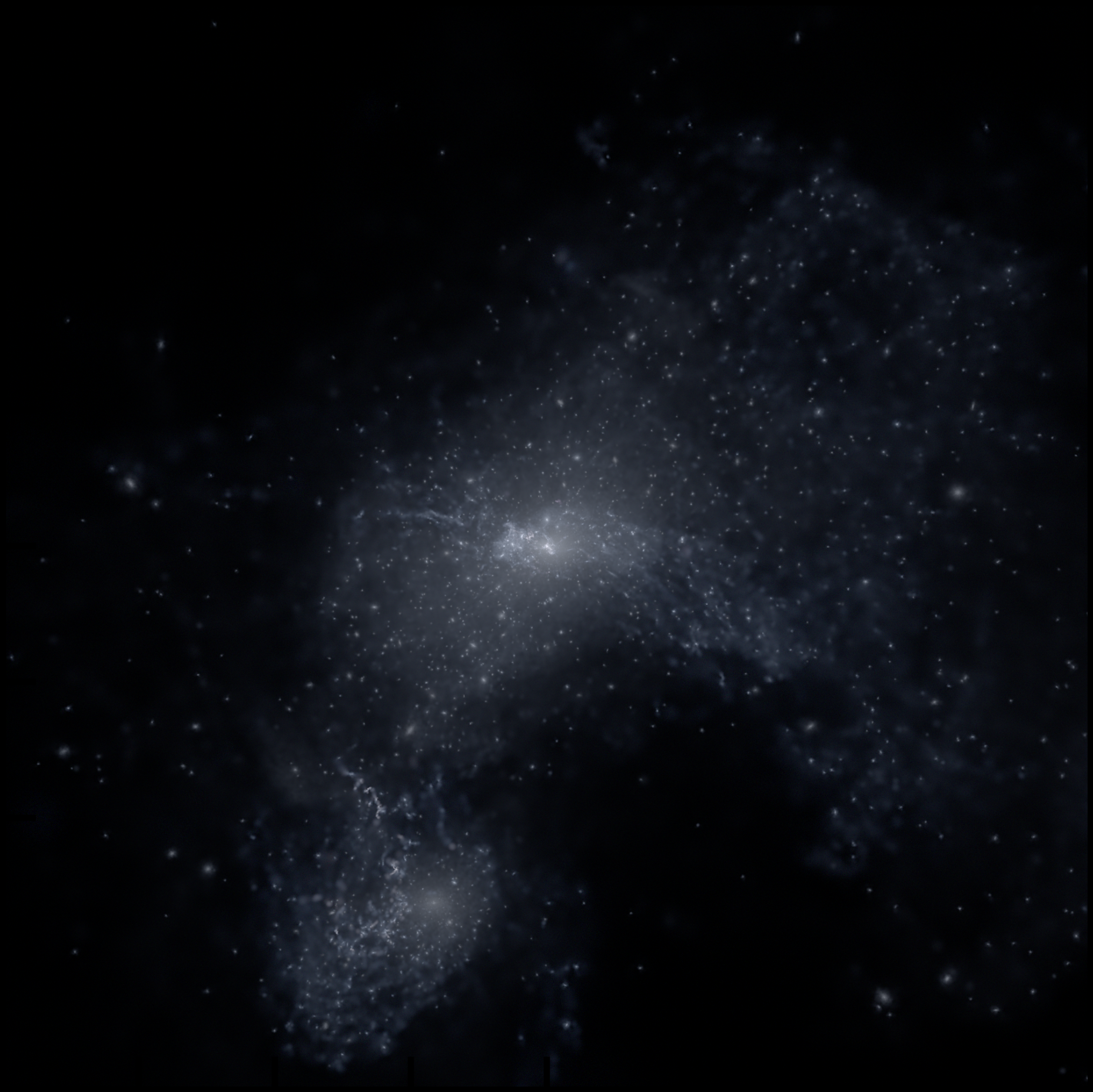
In Bardati et al. (2024a), we use synthetic observations of galaxies in a high-resolution cosmological simulation with accurate black hole dynamical friction prescriptions to show that the presence of long-lived morphological features such as prominent bulges or a clumpy stellar distribution can be promising indications of SMBH merger hosts. In Bardati et al. (2024b), we also show that SMBH merger hosts have signatures in their kinematics and are characterized by a slower rotation and stronger kinematic misalignments. We use these methods in Horlaville et al. (2025) to make predictions of SMBH merger host galaxies in our local universe from archival surveys.

Contact

I am best reached by email: jbardati@caltech.edu.